
Your entryway is the first thing guests see. If it’s just a coat hook and a pile of shoes, it won’t make a great impression. I’ve loved mid-century modern design for years.
This style can transform an entryway like no other. It’s warm, intentional, and blends retro charm with timeless elegance.
The best part? You don’t need a big budget or a design degree. Mid-century modern decor is based on simple, logical rules.
Once you grasp what makes this style work, every choice in your space feels clear, not daunting.
What Mid-Century Modern Actually Means for Your Entryway
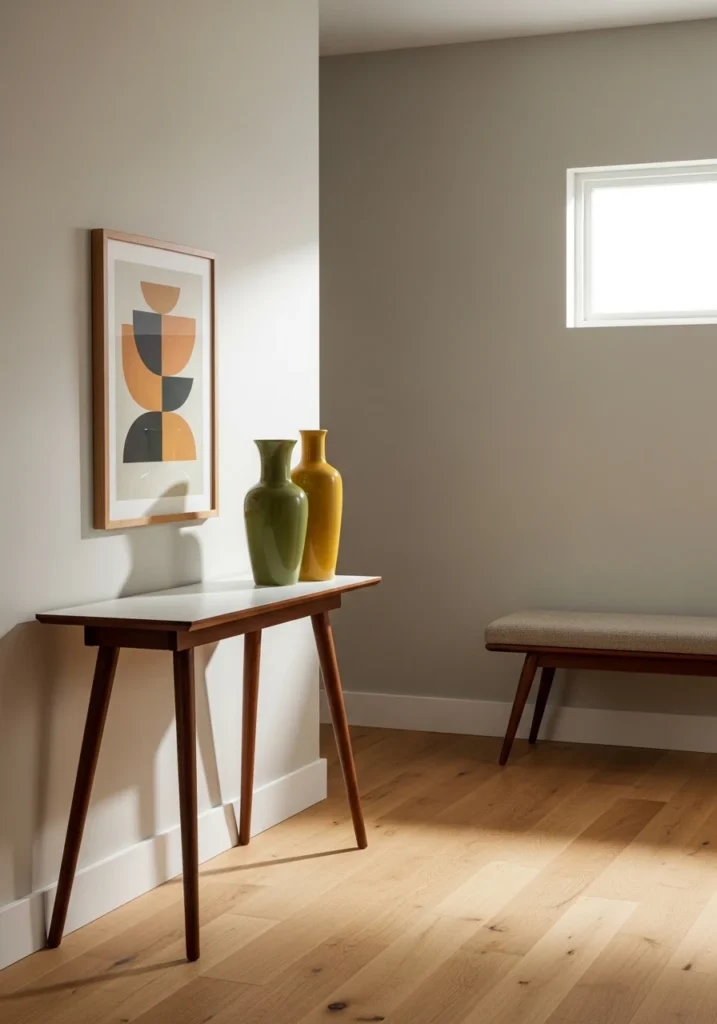
People throw this term around a lot, so let us get specific about what it actually looks like in practice.
Mid-century modern design grew out of the post-World War II era, roughly spanning the 1940s through the 1960s.
Designers back then were reacting against heavy, ornate Victorian excess and building something leaner and more purposeful.
The guiding principle was simple: form follows function. Every piece in the space should look good and do something useful.
There is no room for purely decorative clutter in a true mid-century modern scheme, and honestly, that constraint is what makes it so satisfying to design around.
The Style’s Non-Negotiable Hallmarks
Before you buy a single thing, make sure you understand what belongs in this aesthetic and what does not. Here is what defines the mid-century modern look:
- Tapered legs on all furniture, keeping pieces low and grounded
- Natural warm wood tones like walnut, teak, and oak
- Brass, matte black, or brushed gold hardware rather than chrome or silver
- Organic and geometric shapes that feel deliberate, never random
- A warm, earthy base palette with bold accent colors used sparingly
- Negative space treated as a design element, not wasted room
Keep this list on hand as a quick filter whenever you are tempted to add something to the space. If it does not check at least a couple of these boxes, it probably belongs somewhere else.
The Console Table: Your Entryway’s Most Important Investment
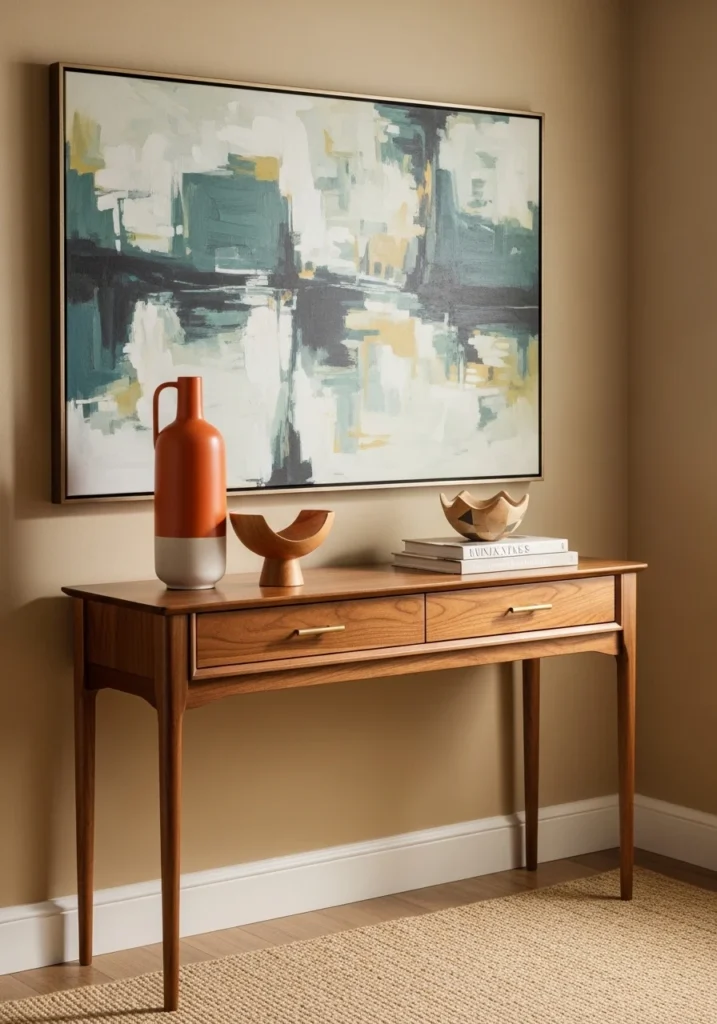
If you only buy one piece of furniture for your mid-century modern entryway, make it the console table.
This is the anchor of the entire space, and getting it right makes every other decision significantly easier.
I learned this the hard way after trying to build an entryway vignette around a table that was just slightly wrong, and nothing else ever looked quite right because of it.
Look for a console with tapered wooden legs, a flat clean-lined top, and minimal to zero ornamentation.
Walnut is the gold standard finish because its warm, dark grain reads as unmistakably mid-century. If your entryway runs lighter and more airy, an oak or ash finish works beautifully too.
Shop Mid-Century Modern Console Tables On Amazon
Storage Versus Style: You Can Have Both
One common mistake people make is choosing a purely decorative console that offers zero storage. Your entryway needs to function, full stop.
The good news is that mid-century modern design celebrates functional furniture, so a console with a slim drawer or two fits perfectly within the aesthetic while also giving you somewhere to throw your keys.
A console table with one or two slim drawers is the sweet spot for most entryways. It keeps the profile clean and low while handling everyday chaos behind closed fronts.
Style the top surface with restraint, and you get a space that looks effortlessly curated rather than constantly managed.
Lighting That Does More Than Just Illuminate
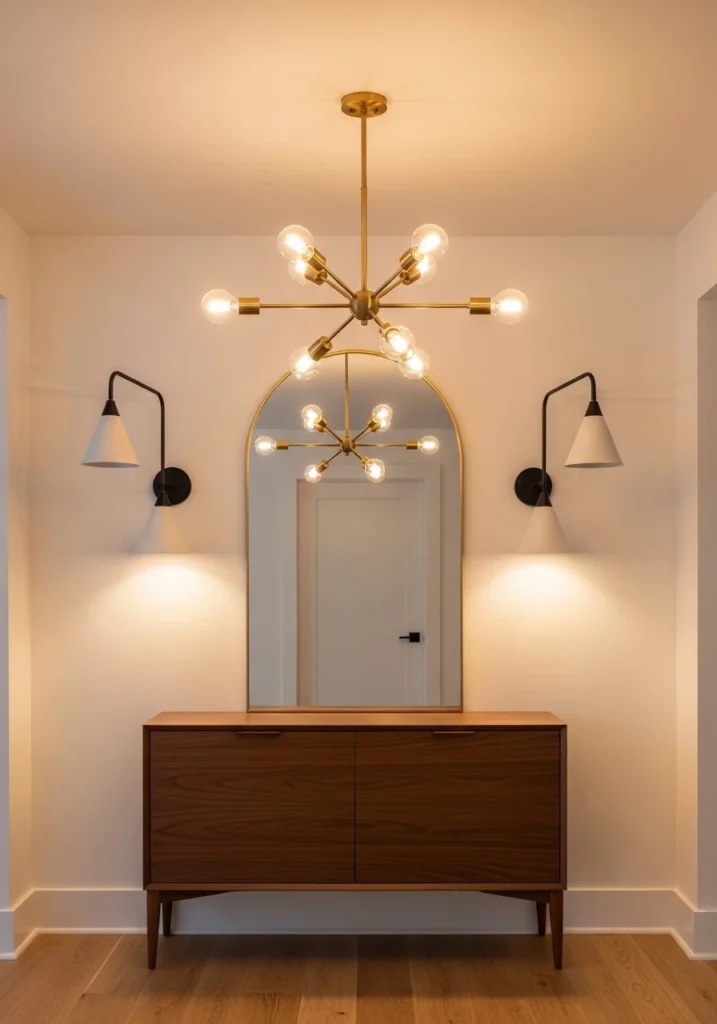
Lighting in a mid-century modern entryway pulls a lot of weight, and treating it as an afterthought is a wasted opportunity.
The right fixture does not just light the space, it punctuates the design and tells visitors exactly what kind of home they have walked into.
Sputnik chandeliers remain the most iconic mid-century modern lighting choice, and their staying power is entirely deserved.
Those starburst arms with exposed globe bulbs hit every visual note the style demands: geometric, bold, functional, and subtly playful.
If your ceiling height cannot accommodate a hanging fixture, a sculptural flush-mount with an organic or atomic-age shape steps in beautifully.
Browse Mid-Century Modern Light Fixtures On Amazon
Sconces for Layered Light and Visual Balance
Wall sconces give you a second layer of lighting that also serves a compositional purpose.
Flanking a mirror or a piece of art with two matching sconces creates a balanced, considered arrangement that feels professionally designed without requiring a professional designer.
Choose sconces with brass or matte black arms and simple geometric shades.
Pair them with warm-toned bulbs because cool white light fights against the warm wood tones and earthy palette that mid-century modern depends on.
The bulb temperature matters more than most people realize, so aim for bulbs in the 2700K range.
Mirrors That Work as Hard as They Look
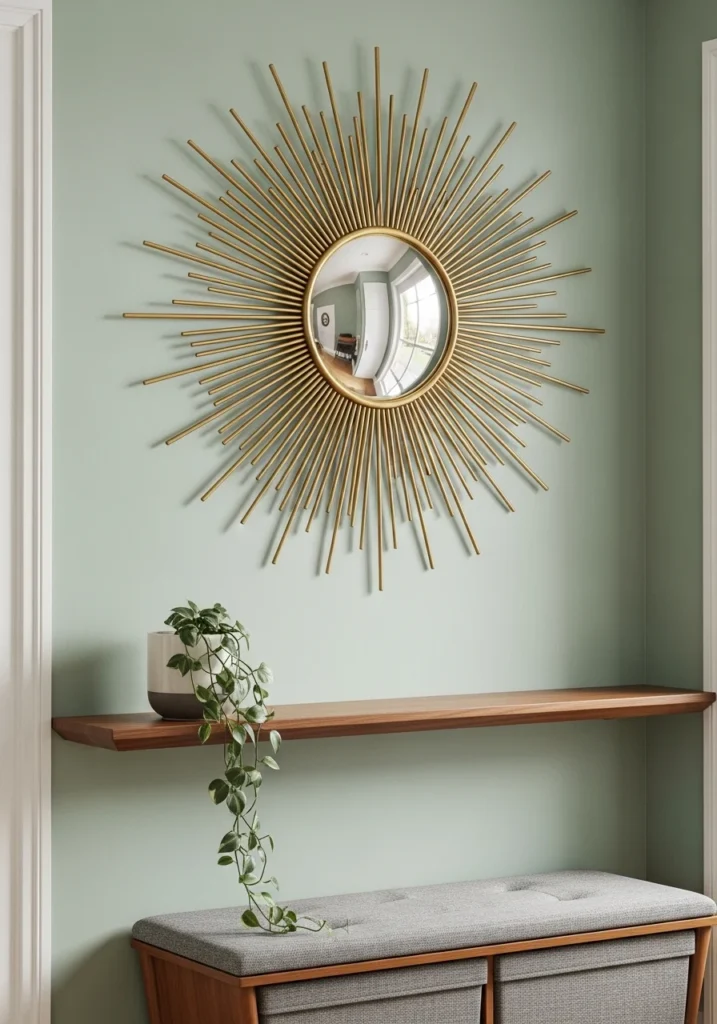
A mirror is practically mandatory in an entryway, partly for the last-glance-before-you-leave practicality and partly because a well-chosen mirror adds light, depth, and visual height to a compact space.
In a mid-century modern entryway, the mirror itself becomes a statement piece rather than a utilitarian afterthought.
Sunburst and starburst mirrors in brass or warm metal tones are the most recognizable mid-century modern option, and they earn their reputation by working exceptionally well.
If you find them too common for your taste, a simple round mirror with a thin walnut frame is quieter but equally effective.
Find Mid-Century Modern Mirrors On Amazon
Getting the Scale and Placement Right
Scale is where people most often go wrong with entryway mirrors. A mirror that is too small on a large wall looks accidental rather than intentional.
Aim for a mirror whose width spans roughly one-third to half the width of your console table so the two pieces feel visually related rather than randomly placed.
Hang the mirror so its center sits 57 to 60 inches from the floor. This is the standard gallery-hang height and it works well for most people’s eye level.
In a narrow hallway entryway, consider a large leaning mirror instead because it adds depth and feels less constrained by the tight proportions.
Color: Warm Base, Bold Accents
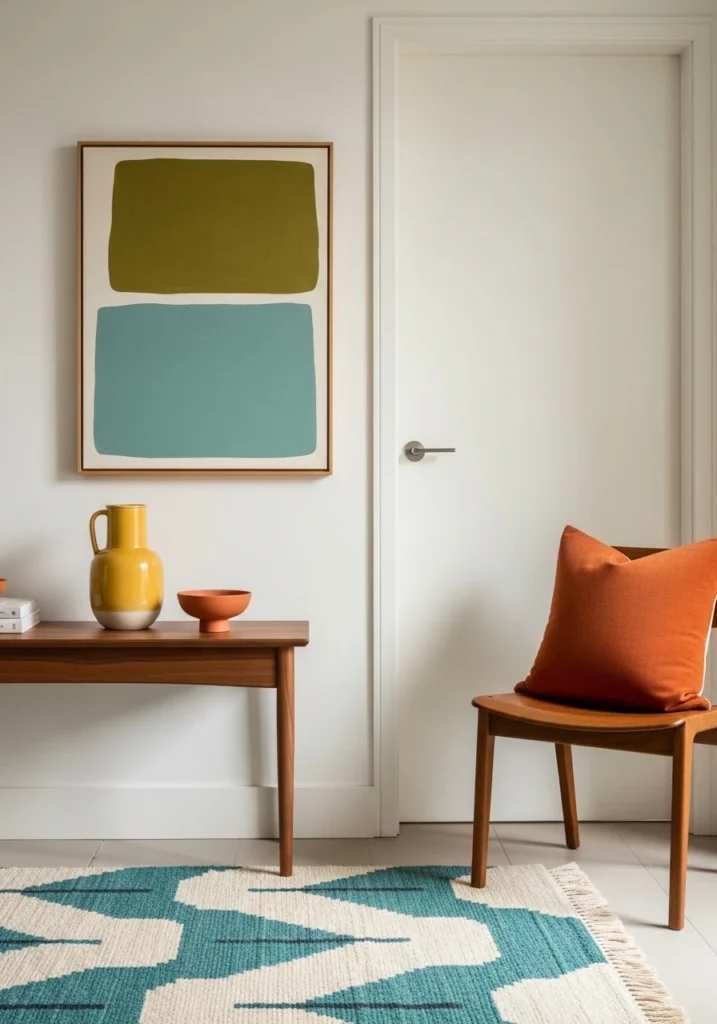
Getting the color palette right is what separates a mid-century modern entryway that genuinely wows from one that just has some retro furniture in it.
The style uses color in a very specific way that feels cohesive and intentional rather than busy.
Start with a warm neutral base: think cream, warm white, greige, or a soft tan on the walls. This lets your furniture and natural wood tones breathe and take center stage.
Then you bring in one or two accent colors through smaller objects and textiles.
The most authentic mid-century modern accent colors include:
- Mustard yellow for warmth and that unmistakably retro edge
- Olive or sage green for a grounded, organic feel
- Burnt orange or terracotta for a bold, earthy punch
- Teal or dusty turquoise for cool contrast against warm wood
You do not need all of these at once. Pick one dominant accent and maybe a quiet secondary one, then let those colors guide your choices in ceramics, art, and textiles.
The Entryway Rug Ties It Together
A mid-century modern entryway rug is one of the most powerful tools you have for anchoring the palette and defining the space.
Look for geometric patterns, abstract designs, or simple striped compositions in muted, earthy tones. Wool rugs in natural fibers complement the material palette of the style perfectly.
Sizing matters here just as much as it does with mirrors. The rug should be large enough to sit visibly under or in front of the console table and cover a meaningful portion of the floor.
A tiny rug floating in a large entryway looks like it wandered in from a different room.
Shop Mid-Century Modern Entryway Rugs On Amazon
Decor Objects: The Art of Editing
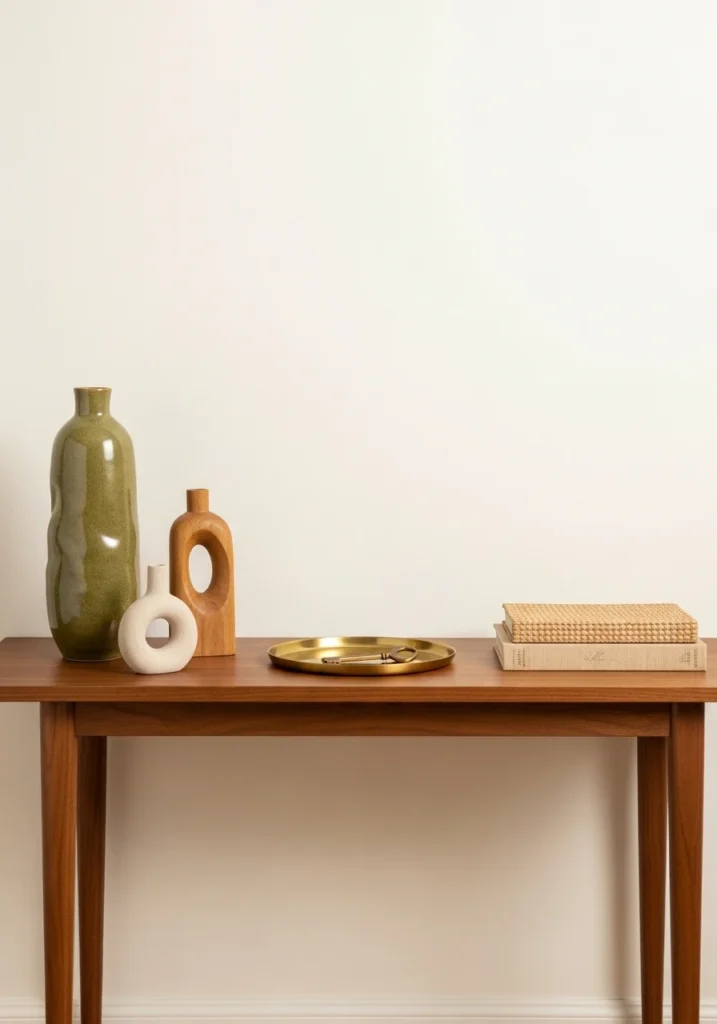
Here is where a lot of people overcomplicate things. Mid-century modern decor is not about filling every surface with carefully sourced vintage objects.
It is about choosing a small number of great pieces and giving them room to breathe.
Less really is more here, and I say that as someone who had to learn it through trial and embarrassing error.
On your console table, three to five objects is generally the limit. A good starting arrangement might include:
- One tall ceramic vase in an organic shape and earthy tone
- One smaller sculptural object like a ceramic bowl or abstract figurine
- A small tray in wood or brass for holding everyday items like keys
- One trailing plant or a cut branch for organic texture
That is it. The negative space around these objects is just as important as the objects themselves.
Plants and Greenery Earn Their Place
A single well-chosen plant adds life and verticality that no manufactured object can replicate.
A snake plant, fiddle leaf fig, or olive tree works beautifully in a mid-century modern entryway because their sculptural shapes complement the style’s organic sensibility.
Keep the planter simple: a matte ceramic or a woven basket rather than anything glazed or ornate.
Art That Signals the Era Without Being a Time Capsule
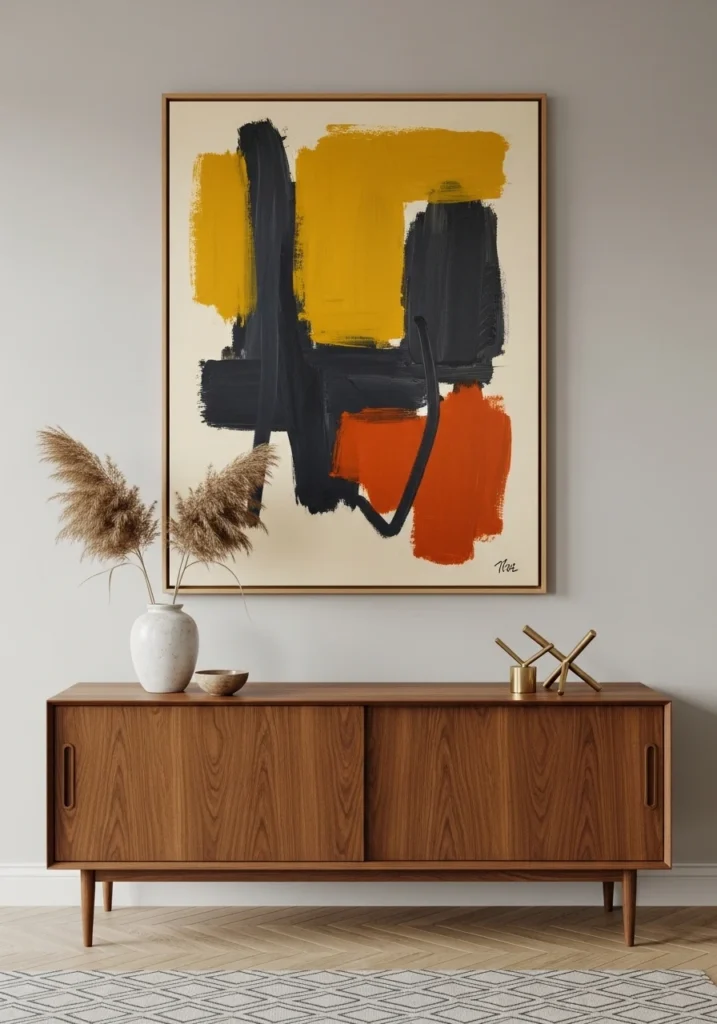
Art choices in a mid-century modern entryway should feel period-informed but not like you raided a 1962 estate sale. The goal is to reference the aesthetic intelligently, not to recreate it literally.
Abstract expressionist prints, graphic geometric compositions, and vintage travel posters from the 1950s and 60s all work wonderfully.
Look for pieces with bold, simple compositions and colors that connect to your accent palette.
One large piece above the console tends to work better than a gallery wall because the style favors restraint over abundance.
Frame your art simply. A thin walnut or oak frame lets the artwork do the talking without competing with it. Avoid ornate gold frames, which push the vibe somewhere much more traditional.
Functional Storage: Because Real Life Is Messy
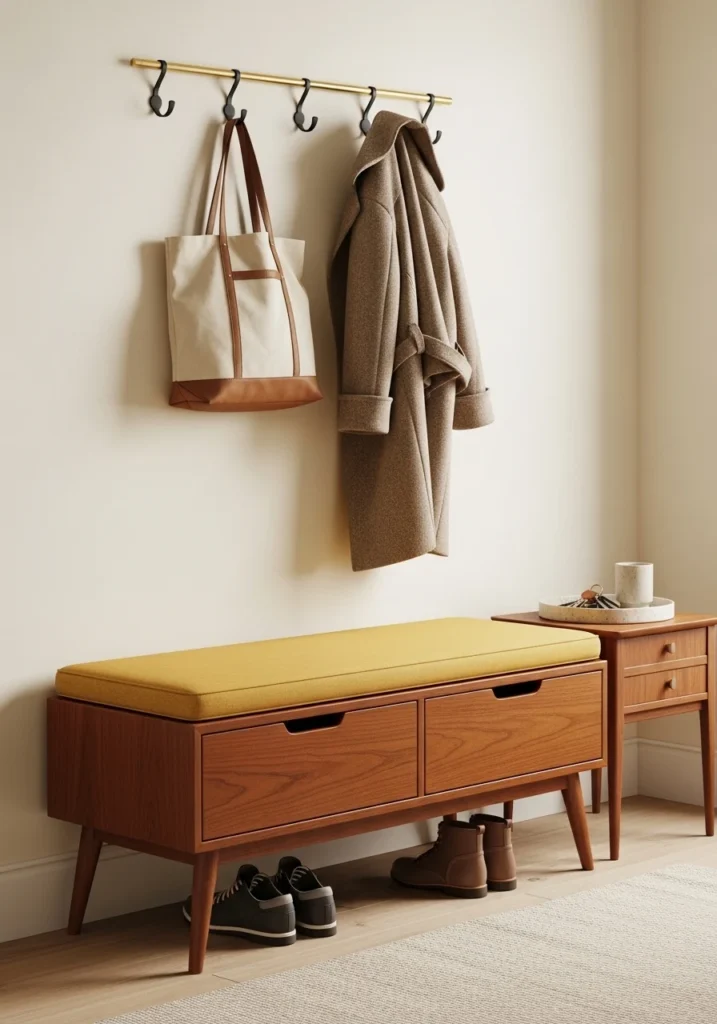
A mid-century modern entryway that looks perfect in photos but offers nowhere to put your coat is genuinely useless.
The style’s commitment to functional beauty means you can create serious storage without sacrificing the aesthetic at all.
A storage bench with tapered legs and a cushioned top solves multiple problems at once: seating for putting on shoes, storage inside, and a visual anchor at floor level.
A wall-mounted coat rack with brass or matte black hooks handles outerwear without eating into floor space.
Both pieces exist in abundance within the mid-century modern design language, so finding ones that fit the look is easier than you might expect.
Browse Entryway Storage Benches And Coat Racks On Amazon
Putting the Whole Look Together
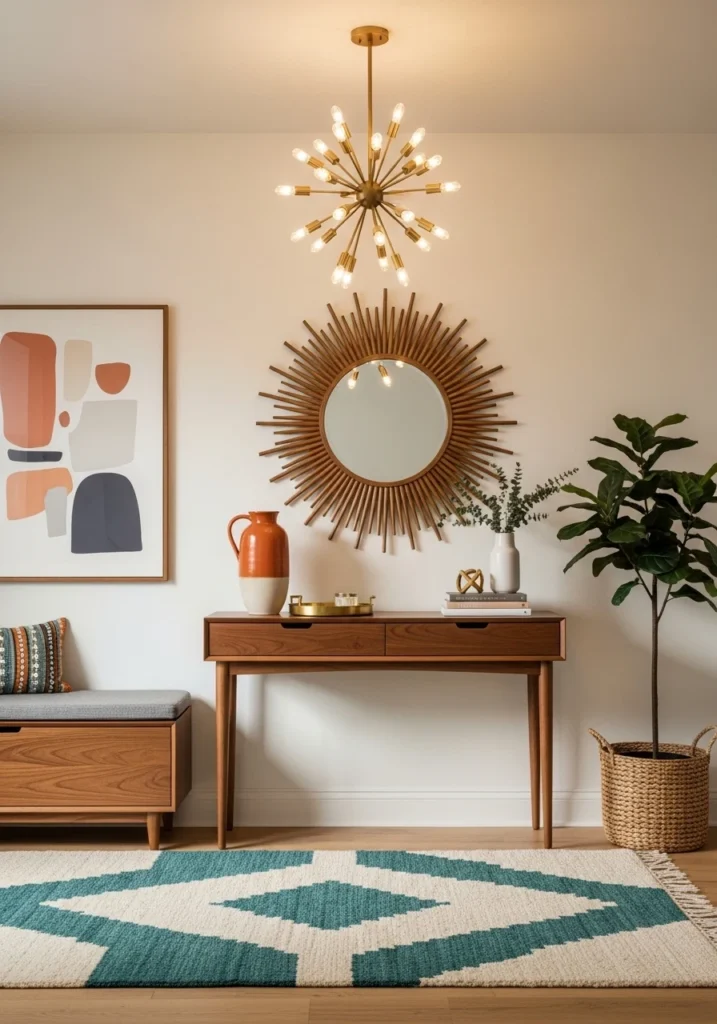
A mid-century modern entryway that truly wows is never the result of just buying the right furniture.
It comes from understanding how all the elements relate to each other: the console anchors the space, the mirror adds dimension, the lighting adds drama, the rug defines the zone, and the decor objects provide the finishing personality.
Edit ruthlessly at every stage. When something does not look right, the answer is almost always to remove rather than add.
The restraint built into this design philosophy is not a limitation. It is what gives the style its confidence and staying power.
Start with one strong piece, let that guide the next decision, and keep going from there.
Before long, your entryway will stop being just a place where people take off their shoes and start being the kind of space that genuinely makes people pause when they walk through the door.
And that, honestly, is a pretty satisfying thing to pull off.
What Are the Key Elements of a Mid-Century Modern Entryway?
A mid-century modern entryway usually has a low-profile console table with tapered legs. It features warm wood tones like walnut or teak.
A statement mirror, often a sunburst or round design, adds character. Geometric or abstract area rugs complete the look.
Lighting is important too. Popular choices include Sputnik chandeliers and sculptural sconces.
The style focuses on clean lines and functional furniture. It uses a warm earthy color palette, with bold accent colors used sparingly.
What Colors Work Best in a Mid-Century Modern Entryway?
The best color palette for a mid-century modern entryway starts with a warm neutral base on the walls. Use colors like cream, warm white, or greige.
Then, add one or two accent colors with decor and textiles. Authentic mid-century modern accent colors include mustard yellow, olive green, burnt orange, terracotta, and dusty teal.
Keep the accent use limited so warm wood tones and natural materials stay the main focus.
What Type of Console Table Works Best for a Mid-Century Modern Entryway?
The best console table for a mid-century modern entryway features tapered wooden legs, a flat top, and minimal hardware. Walnut and teak finishes are the most accurate.
Lighter oak tones suit brighter spaces nicely. Look for a table with one or two slim drawers for practical storage that keeps the clean look.
Avoid glass tops, heavy turned legs, and ornate carvings, as these details stray from the mid-century modern style.
How Do You Add Storage to a Mid-Century Modern Entryway Without Ruining the Look?
You can add practical storage to a mid-century modern entryway with multi-functional furniture. A storage bench with tapered legs and a cushioned seat gives you seating and hidden storage.
A wall-mounted coat rack with brass or matte black hooks holds outerwear without using floor space.
For larger entryways, a low credenza or sideboard provides ample storage and acts as a strong horizontal anchor for the space.
How Do You Style a Console Table in a Mid-Century Modern Entryway?
Style a mid-century modern console table by keeping the surface clean and purposeful.
Use three to five objects at most: a tall ceramic vase with an organic shape, one smaller sculptural piece, a simple wood or brass tray for keys, and optionally a trailing plant or cut branch for texture.
The negative space around these items matters just as much as the items themselves. Avoid filling every inch of the surface. Restraint gives mid-century modern styling its confident, polished look.