
There’s something satisfying about stepping into a traditional living room. Everything feels in its right place.
The furniture anchors the space, and the curtains frame the windows. But then you look down, and… nothing.
A bare floor that seems to say, “I gave up.” Sound familiar? If you want to enhance your traditional living room without a full renovation, a statement rug is your best move.
A great rug does more than cover the floor. It sets the room’s tone, ties your furniture together, and adds texture, color, and personality.
No amount of throw pillows can match that. Let’s explore how to choose the right rug.
Why a Statement Rug Changes Everything in a Traditional Living Room
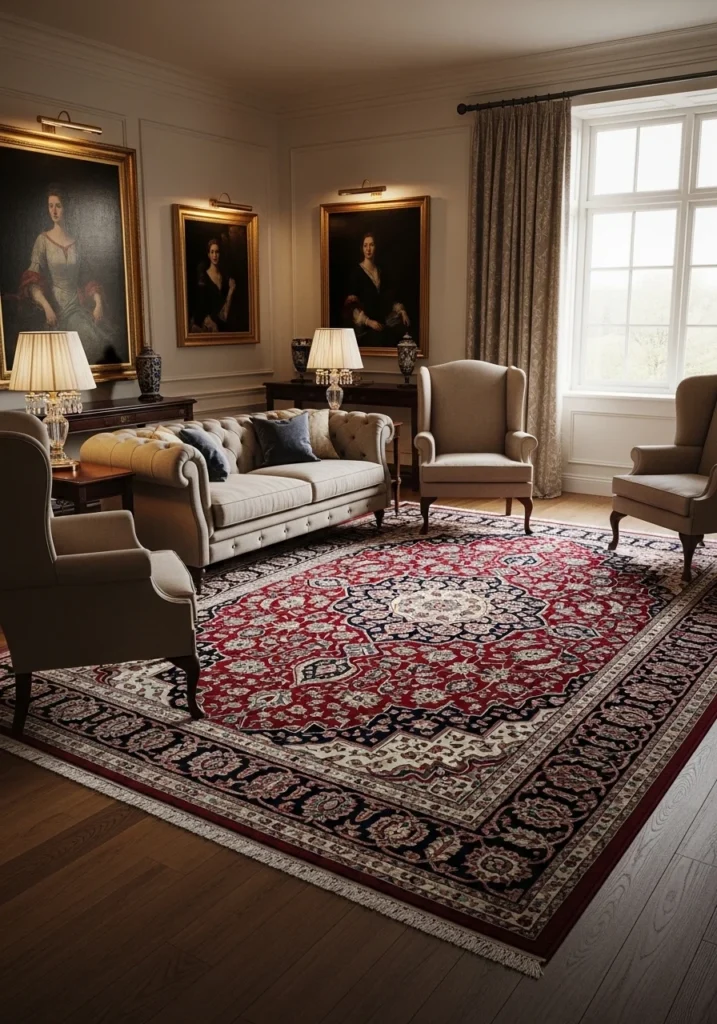
Traditional living rooms thrive on layering, symmetry, and a sense of intentional elegance. Every element should feel like it was chosen with purpose.
A statement rug steps into that role with remarkable confidence, essentially acting as the visual foundation from which every other design decision radiates outward.
Think of it this way. Your sofa, coffee table, armchairs, and side tables are all floating in space without an anchor.
A rug pulls them together into a defined seating area, which makes the room feel curated rather than simply furnished.
The rug does not just decorate the floor; it organizes the entire room.
Beyond organization, a statement rug in a traditional setting adds warmth, both literally and aesthetically.
Hardwood floors are beautiful, but they can feel cold and disconnected in a room that aims for comfort and grandeur.
The right rug softens that and invites people to sit, stay, and settle in.
What Makes a Rug a “Statement” Rug
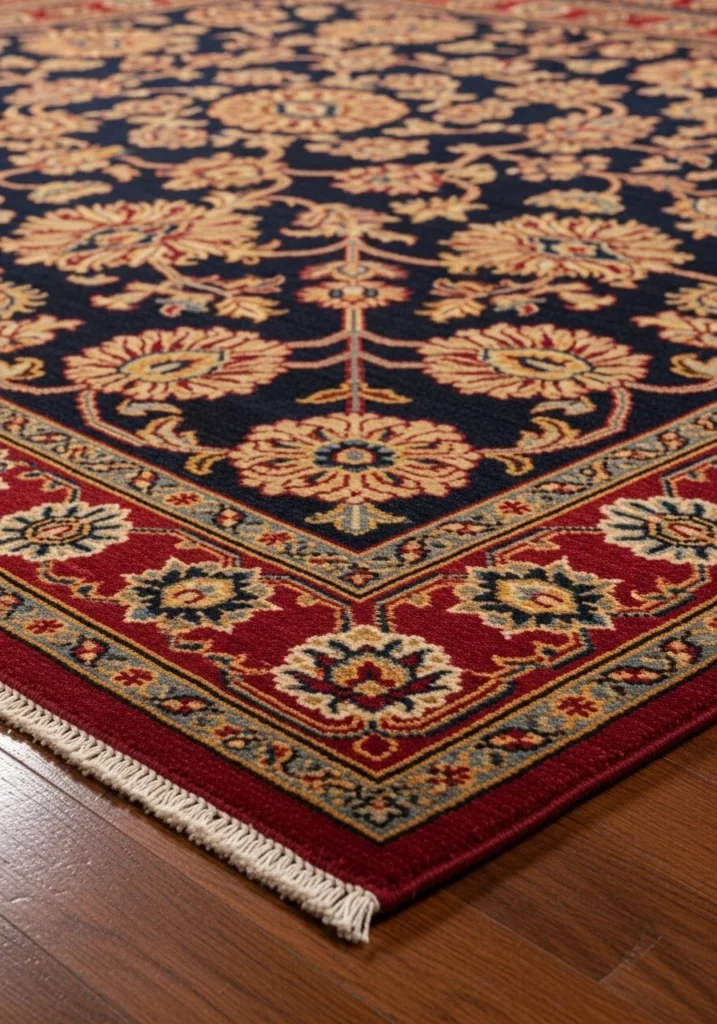
Not every rug qualifies as a statement piece. A beige runner you grabbed on sale? Probably not making any statements.
A statement rug commands attention, sparks conversation, and holds its own alongside even the boldest furniture.
Here is what separates a statement rug from a background rug:
- Scale: A statement rug is large enough to anchor the entire seating area. In most living rooms, that means at least 8×10 feet, often larger.
- Pattern: It carries a bold, detailed, or intricate design that draws the eye immediately.
- Color: It introduces or reinforces the room’s color palette in a confident, unmistakable way.
- Texture: It has a pile depth or weave that adds tactile interest, not just visual interest.
- Craftsmanship: Hand-knotted, hand-tufted, or high-quality machine-made rugs with visible artistry elevate the space instantly.
A statement rug does not necessarily mean loud or overwhelming. In a traditional living room, it often means refined, deeply detailed, and quietly magnificent.
Browse Statement Rugs on Amazon
The Best Rug Styles for a Traditional Living Room
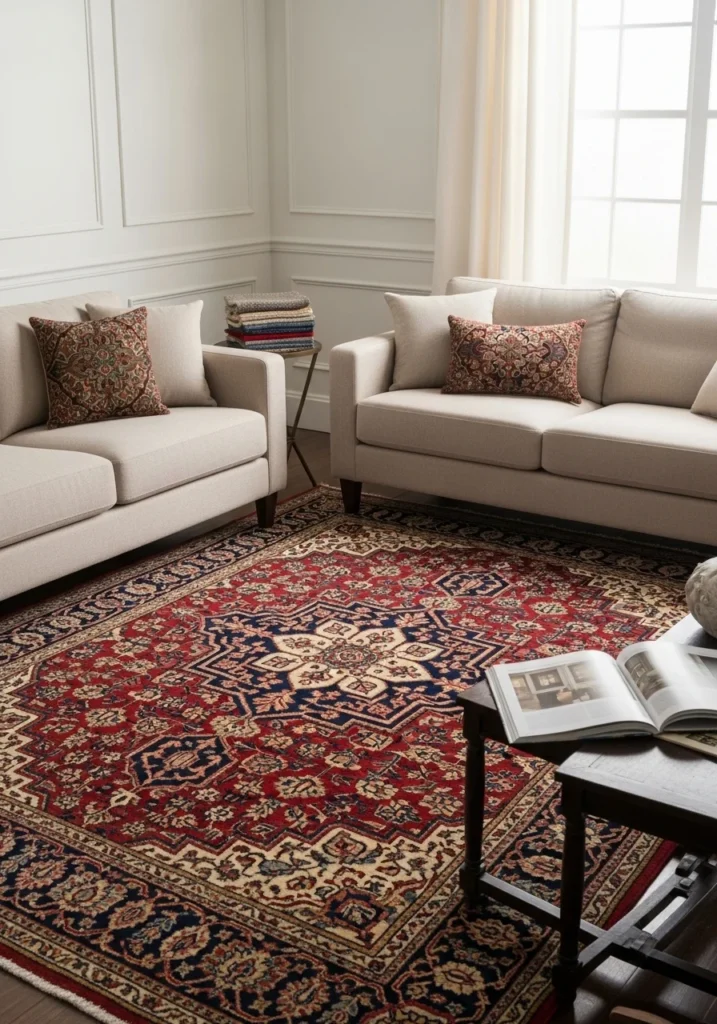
Persian and Oriental Rugs
If traditional elegance had a mascot, it would be the Persian rug. These rugs have decorated grand homes for centuries, and they earn that reputation every single day.
Persian and Oriental rugs feature intricate medallion patterns, floral motifs, and rich color combinations, typically deep reds, navy blues, ivory, and gold, that feel tailor-made for traditional interiors.
Hand-knotted Persian rugs are especially prized because of the density of their knots and the sheer amount of time and skill that goes into producing them.
A quality hand-knotted rug can last for generations. That is not marketing language. That is just the truth of what careful craftsmanship produces.
Shop Persian and Oriental Rugs on Amazon
Traditional Wool Rugs
Wool is the gold standard material for traditional rugs, and for good reason.
It is durable, naturally stain-resistant, and it holds dye beautifully, which means colors stay rich and vivid over time.
A wool rug in a traditional living room feels appropriate in a way that synthetic materials simply cannot replicate.
Look for rugs with a high wool pile that gives you that satisfying density underfoot. A quality wool rug should feel substantial, not papery.
If you can practically see through it when you hold it up to light, keep shopping.
Find Quality Wool Rugs on Amazon
Aubusson and Needlepoint Rugs
These flat-weave or low-pile rugs originate from French tapestry traditions, and they bring an aristocratic, European elegance to any traditional space.
Aubusson rugs typically feature pastoral scenes, floral wreaths, and muted, sophisticated palettes that work beautifully in rooms furnished with antiques or classic upholstered pieces.
They tend to be thinner than pile rugs, which makes them a smart choice if your furniture is particularly heavy or if you prefer a sleeker look at floor level.
Kilim and Flatweave Rugs with Traditional Motifs
Kilim rugs offer a slightly more relaxed version of traditional elegance.
Their flat-weave construction gives them a graphic, bold quality that works wonderfully in transitional spaces, rooms that lean traditional but incorporate some modern touches.
Look for kilims with geometric medallions, tribal borders, and rich earth tones.
Choosing the Right Size: Please Do Not Go Too Small
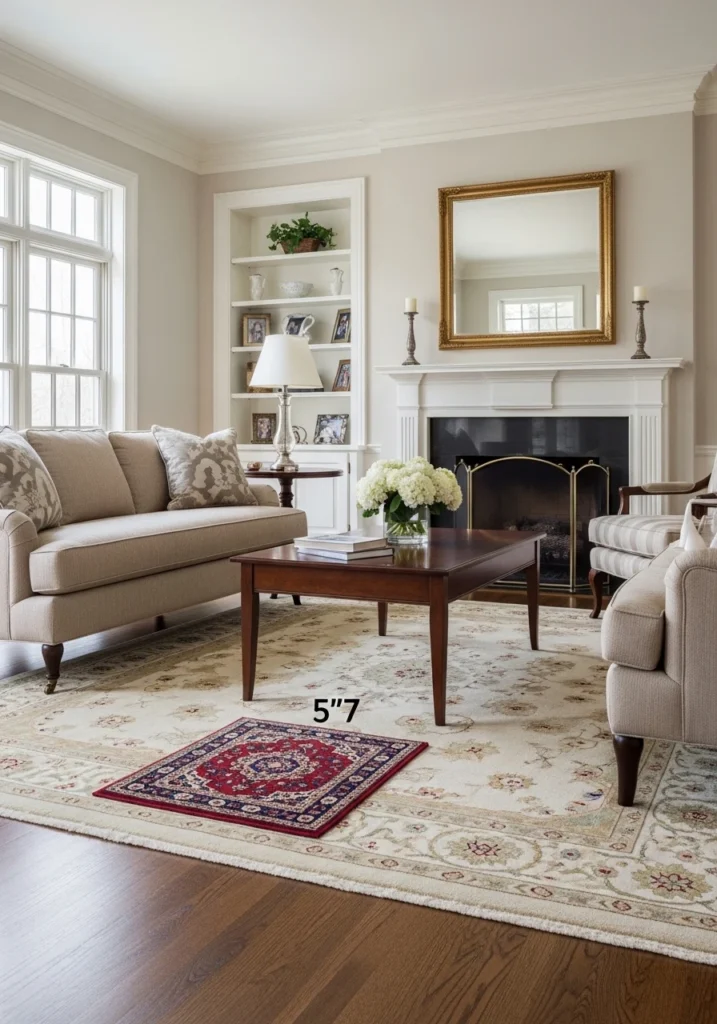
Choosing a rug that is too small is probably the most common and most unfortunate rug mistake people make in living rooms.
A tiny rug floating under a coffee table while the sofa legs hang off the edge in the distance looks a bit like someone forgot to finish decorating.
It throws off the proportions of the entire room.
For a traditional living room, follow these sizing guidelines:
- All furniture legs on the rug: This is the most formal arrangement and works beautifully in larger rooms. It creates a defined, room-within-a-room effect.
- Front legs only on the rug: This is the most popular option for average-sized living rooms. The front legs of the sofa and chairs rest on the rug, which connects the furniture to the rug without requiring an enormous size.
- Rug under coffee table only: Only works in very small rooms and even then, it requires a rug that is at least large enough to extend 18 inches beyond the table on all sides.
When in doubt, size up. A rug that feels almost too large in the store will almost always look right at home once it is laid out beneath your furniture.
Color and Pattern: How to Match Without Being Matchy
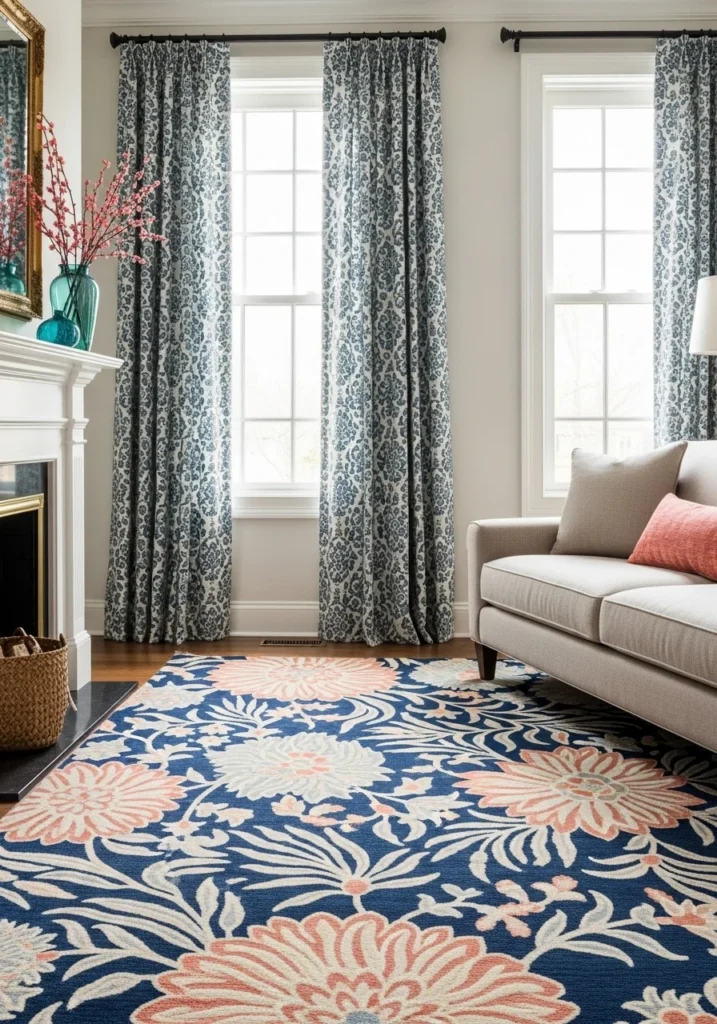
Here is where a lot of people get nervous, and honestly, that nervousness is understandable.
Pairing a boldly patterned rug with existing furniture, curtains, and decor sounds like a recipe for visual chaos.
But traditional design has a well-established logic for making it work.
Pulling Colors from Your Existing Palette
Your statement rug should echo at least two or three colors that already exist in your room. Look at your curtains, upholstery, wall color, and decorative accents.
A rug that picks up those tones, even loosely, will feel connected rather than out of place.
You do not need an exact match. In fact, an exact match can look forced.
A rug that shares the spirit of your color palette while introducing some depth and variation is far more interesting.
Mixing Patterns the Smart Way
Traditional living rooms often layer multiple patterns, and statement rugs sit confidently among them. The key is varying the scale of your patterns.
If your sofa fabric features a small check or a fine stripe, a rug with a large-scale medallion pattern will complement it rather than compete with it.
- Large pattern rug + small pattern upholstery = harmonious layering
- Two large patterns at the same scale = visual tension (avoid this)
- Solid upholstery + patterned rug = a classic, foolproof combination
Placement and Styling Tips That Actually Work
Define Your Seating Area First
Before you even start shopping for a rug, mark out your seating area with painter’s tape on the floor.
This gives you a realistic picture of what size rug you need and where it should sit. Most people discover at this stage that they need a larger rug than they initially thought.
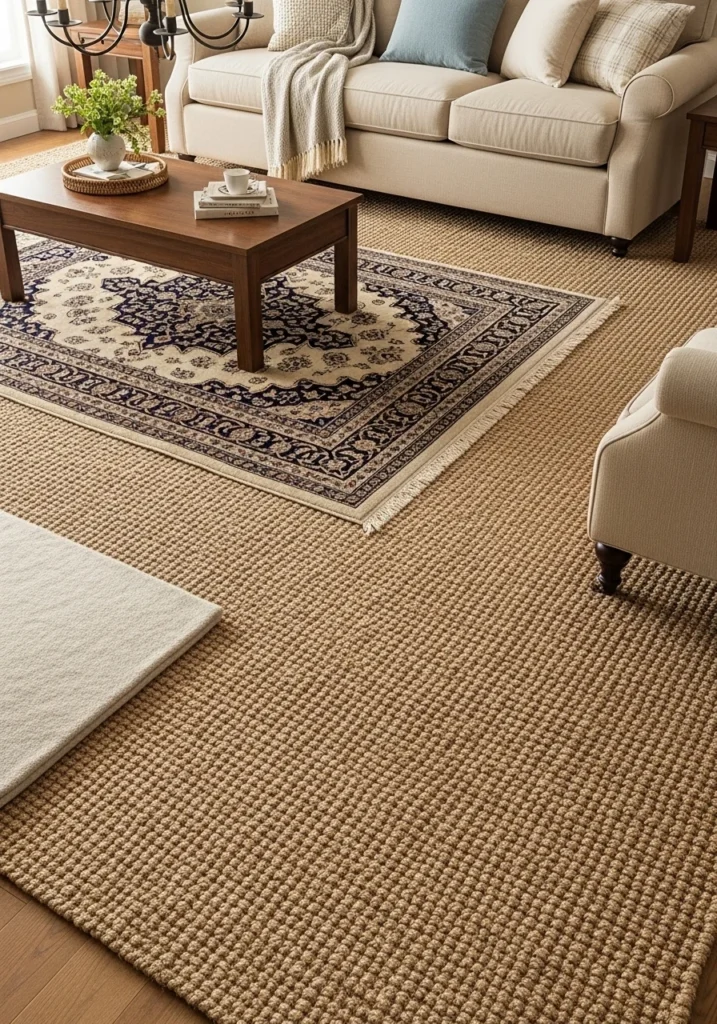
Layer Your Rug for Extra Depth
Layering rugs is a technique that traditional interiors handle particularly well.
Place a natural fiber rug, jute or sisal, as a base layer, then position your statement rug on top.
This adds visual depth, defines the space even more clearly, and gives you an opportunity to introduce texture contrast.
Keep the Rug Pad Non-Negotiable
A quality rug pad keeps your rug from sliding, protects your floors, and adds a cushioning layer that makes the rug feel even more luxurious underfoot.
Never skip the rug pad. It extends the life of the rug and keeps it looking pristine for years longer than it otherwise would.
Caring for Your Investment
A true statement rug, particularly a hand-knotted wool piece, represents a significant investment. Treat it accordingly.
- Vacuum regularly using a suction-only setting, without the beater bar, which can damage wool fibers over time.
- Rotate the rug every six to twelve months to ensure even wear and sun exposure.
- Address spills immediately by blotting, never rubbing, with a clean cloth.
- Have the rug professionally cleaned every two to three years, depending on foot traffic.
A well-maintained rug does not just survive; it improves with age, developing what rug collectors call a patina, a subtle softening of color and texture that only deepens its beauty.
Shop Traditional Living Room Rugs on Amazon
Final Thoughts
A statement rug in a traditional living room is not an accessory. It is a decision, one that sets the tone for everything else in the space.
Get it right and the entire room seems to exhale with satisfaction. Get it wrong and even the most beautiful furniture will feel slightly adrift.
The good news is that choosing well is not as complicated as it might seem once you understand the fundamentals: go big on size, choose quality materials, find a pattern that speaks to your room’s existing palette, and place it with intention.
Your living room has been waiting for this. Give it the foundation it deserves.
What Size Rug Works Best for a Traditional Living Room?
For most traditional living rooms, an 8×10 or 9×12 rug is ideal. The front legs of your main seating should rest on the rug.
This anchors the furniture and defines the seating area. In larger, formal rooms, choose a bigger rug.
This lets all four legs of each piece sit fully on it, creating a grander look. Always use painter’s tape to outline the space on your floor before buying.
What Type of Rug Is Most Suitable for a Traditional Living Room?
Persian and Oriental hand-knotted rugs are ideal for traditional living rooms. Their intricate patterns, rich colors, and fine craftsmanship stand out.
Aubusson, needlepoint, and high-quality wool rugs also suit these settings well.
Look for detailed patterns, natural materials like wool or silk, and deep colors such as navy, burgundy, ivory, and gold.
How Do You Choose a Statement Rug Color for a Traditional Living Room?
Identify two or three main colors in your room. Look at your upholstery, curtains, and wall color. Your statement rug should reflect these tones but not match them exactly.
A perfect match can feel forced and flat. Rugs with rich, layered colors offer more flexibility. They can connect with various elements in the room.
If you’re unsure, choose a rug with a deep, neutral base like navy, burgundy, or warm ivory. These colors blend well into most traditional schemes.
How Do You Style a Statement Rug in a Traditional Living Room?
Place the rug so that at least the front legs of your sofa and armchairs rest on it. This connects the furniture to the rug and creates a unified seating area.
Pair bold patterned rugs with smaller patterns on upholstery to avoid visual clash.
You can layer your statement rug over a natural fiber base rug, like jute, for added texture and depth. Always use a quality rug pad underneath.
It prevents slipping, protects your floors, and enhances the rug’s feel underfoot.
How Do You Maintain a Statement Rug in a High-Traffic Living Room?
Vacuum your rug regularly with a suction-only setting. Avoid using the beater bar, as it can harm natural fibers like wool. Rotate the rug every six to twelve months.
This helps wear and sun exposure spread evenly. Blot spills right away with a clean cloth. Rubbing can spread the stain.
Schedule a professional deep clean every two to three years. In high-traffic homes, consider more frequent cleaning.
This keeps your rug looking good and helps it last longer.